Story Worth Keeping · Origin
The Penny That Bought a Coffee and an Education
For the price of a coffee, seventeenth-century Londoners bought entry to rooms that produced modern insurance, the stock exchange, and the Enlightenment.
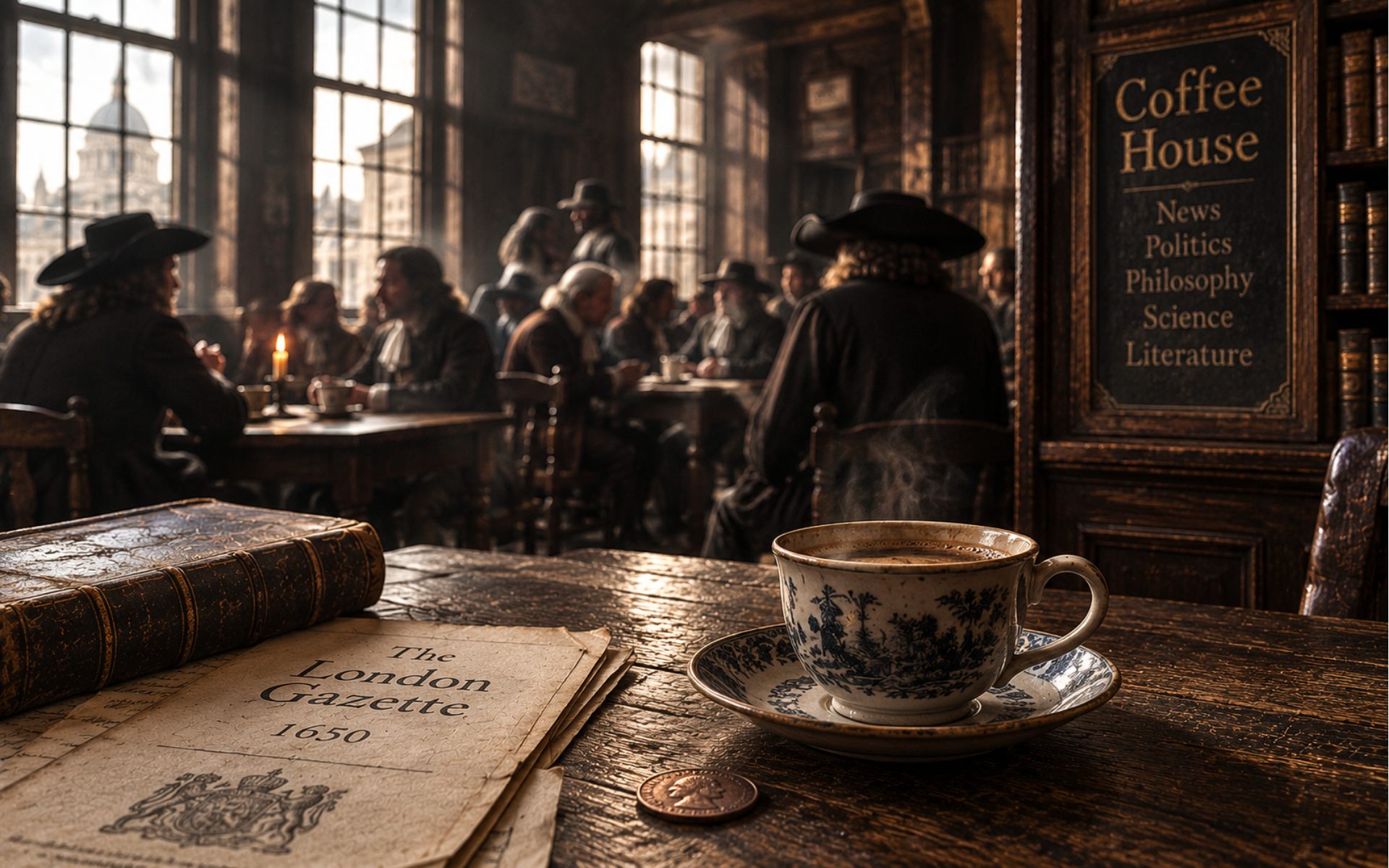
A penny bought a cup of coffee. What you actually got was an education.
What Actually Happened
Before coffee, Europe drank beer — often at breakfast. Water was unsafe, and the day began mildly drunk.
Then, in the mid-1600s, coffee arrived in London, and something changed. For the first time, there was a public place where people gathered to be alert rather than intoxicated — sober, sharp, and talking. The coffee house.
Entry cost a penny. So did the coffee. Inside, the usual rules of rank relaxed: a merchant, a scientist and a poet might share the same bench. People came to read the newsletters, hear the latest ship arrivals, do business, and argue. They were nicknamed penny universities, because the conversation was the real thing you bought.
And out of specific coffee houses came specific institutions.
At Edward Lloyd's coffee house, merchants and ship-owners gathered to insure voyages against loss. That gathering became Lloyd's of London — the foundation of the modern insurance market. At Jonathan's coffee house in Exchange Alley, traders in stocks met and dealt until their list of prices became, in time, the London Stock Exchange. In Paris, the Café Procope drew the thinkers whose arguments filled the pages of the Encyclopédie.
Goods were even sold there by candlelight — auctioned in the time it took an inch of candle to burn.
Why It Still Matters
We tend to think big institutions were founded — deliberately, in ceremonies, by people who knew what they were building.
Most of them weren't. They were talked into existence, gradually, by strangers in a room who had somewhere warm to sit and a reason to stay.
The coffee house worked because it did something no institution had done before: it put different kinds of people in the same room, sober, with time. Insurance didn't need a founder so much as it needed a table where the people carrying the risk kept running into the people who could share it. The stock exchange was a list that got too useful to stop keeping.
The buildings changed. The instinct didn't: give people a room and they will build the future in it without meaning to.
The modern world likes to imagine itself planned. A surprising amount of it was simply discussed — over coffee, for a penny, by people who had come in from the cold.
Four centuries later, we still go. That's the remarkable part.
Not that the modern world was built in coffee houses — but that, four hundred years on, we haven't found anywhere better to sit and become who we're going to be next.