Things Worth Remembering · Disruption
The iPhone Killed the Camera Nobody Saw Coming
Kodak invented the digital camera in 1975 and shelved it to protect its film business. Decades later, it was a phone's camera, not a dedicated one, that finished the job.
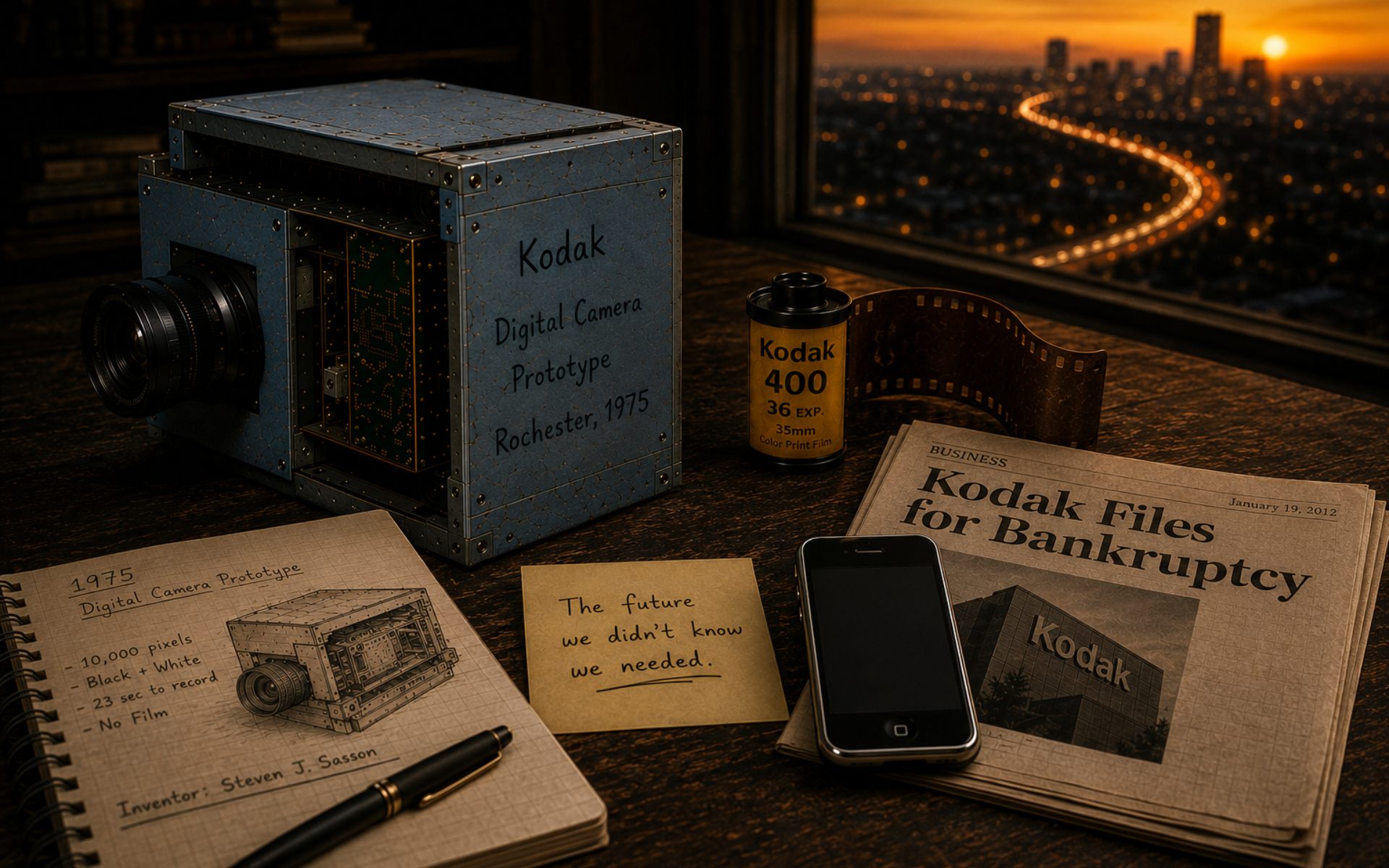
Kodak didn't lose to a rival camera company. It lost to a device that never called itself one.
What Actually Happened
The camera that threatened film was built inside the company that sold it. In December 1975, 24-year-old Kodak engineer Steven Sasson assembled the world's first digital camera. It was roughly the size of a toaster, weighed around eight pounds, captured black-and-white images at just 10,000 pixels and took about 23 seconds to record a photograph. Crude, certainly. But it worked. Film-less photography existed. For Kodak, that created a problem that had little to do with whether the technology worked. Its business was built around film and everything that came after it: processing, printing and the chemicals and equipment that made photography a recurring business. Digital photography threatened that entire chain. Kodak patented the technology and continued researching digital imaging, but the company struggled with the more difficult question: what happens when the technology that could define the future also undermines the business that made you successful? For years, film remained enormously valuable while digital cameras slowly improved. Then the camera changed shape. Digital cameras became smaller and more accessible. And in 2007, Apple put a camera into the iPhone. The camera itself wasn't revolutionary. The combination was. The phone was already in your pocket. It stored photographs, connected to the internet and, increasingly, allowed you to edit and share them without ever leaving the device. You didn't have to remember to bring a camera. You were already carrying one. And Apple wasn't alone for long. Smartphones became a new battleground for photography. Camera sensors, lenses, zoom, computational photography and image processing became reasons to choose one phone over another. The camera had stopped being a separate object. It had become part of the object everyone was already carrying. On January 19, 2012, Kodak filed for Chapter 11 bankruptcy protection.
Why It Still Matters
The strange part of Kodak's story isn't simply that it failed. It's that it had seen the future early enough to know it was coming. The difficult decision wasn't whether digital photography would arrive. It was what to do about a future that threatened the very business that had made Kodak successful. And that is a problem that extends far beyond photography. A company can recognise a technological shift and still struggle to act on it. The better the existing business performs, the harder it can be to dismantle the assumptions that made it successful. Kodak eventually had to. It emerged from bankruptcy in 2013 as a much smaller company, having exited businesses that were no longer central to its future and repositioned itself around commercial imaging, printing and related technologies. That Kodak still exists is part of what makes the story worth remembering. It isn't the same Kodak. Today the company describes itself around commercial print, digital print, traditional print, advanced materials and chemicals, while still maintaining film businesses. Its current printing strategy even combines digital technologies with traditional printing rather than treating the two as opposites. Meanwhile, the technology Sasson built in 1975 went somewhere much bigger than Kodak. It went everywhere. The camera is now inside phones, cars, doorbells and countless other devices. And smartphones don't merely include cameras anymore—they compete on them. A camera that once required its own object has become one of the defining features of another. Kodak didn't disappear. But the camera it invented escaped the boundaries of the company that created it. The company survived by changing. The technology survived by becoming invisible. And perhaps that's the part worth keeping: Sometimes the greatest threat to a successful business isn't a competitor. It's the future arriving in a form you weren't built to sell.